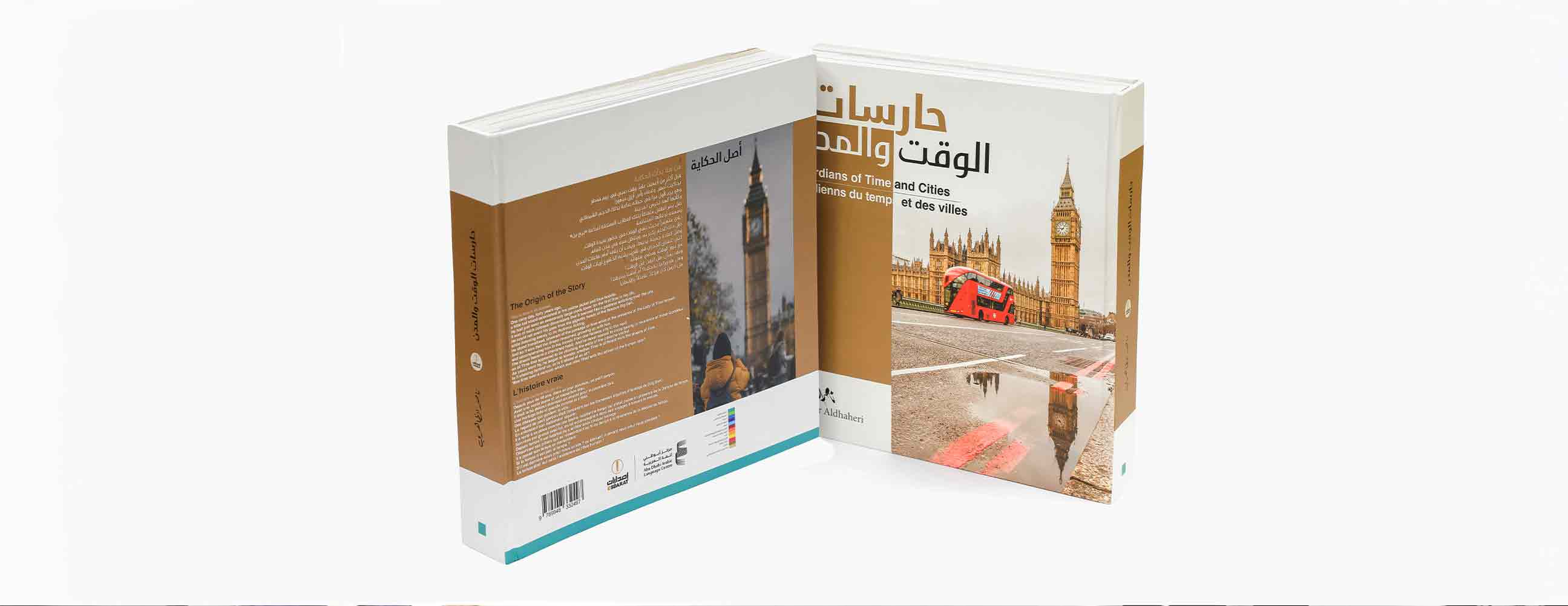
In many cities around the world, clocks have become witnesses to history, enduring mark in memory, and landmarks that capture the attention of visitors. Inspired by this striking presence of time in the fabric of cities, Emirati author Nasser Al Dhaheri set out to write his book, ‘Guardians of Time and Cities’, published by the Abu Dhabi Arabic Language Centre (ALC) in three languages: Arabic, English, and French.
Across 610 pages, the book takes readers on a visual and intellectual journey through around 120 cities, tracing the most renowned and picturesque clocks, from Japan in the east to the United States of America in the west. Al Dhaheri goes beyond documenting their shapes and locations; he reads the stories they tell and explores the civilisational, cultural, and artistic transformations they represent in connection with peoples’ understanding of time.
Photography plays a central role in the book; the author himself captured the images that taken during his travels between cities and landmarks, turning his lens into a tool for exploring the memory of these places. Clocks appear in the book in various forms and functions throughout the book: some are parts of towers and central squares, while others are affixed to historic buildings and monuments, having transformed over time into emblems of their cities and destinations sought out by tourists.
‘Guardians of Time and Cities’ does not so much offer a traditional history of clocks as open a window onto their relationship with places and people. In his introduction, Al Dhaheri recalls his long-standing passion for photographing ancient city clocks, explaining that travel led him to pause before walls embracing old timepieces that stood as witnesses to the events that have transformed cities and their inhabitants.
This personal passion broadens the journey into an exploration of the presence of time within civilisations. The book traces the evolution of instruments used to measure and regulate time, from sundials and hourglasses to water, mercury, and candle clocks, and on to mechanical and astronomical clocks. It then moves on to electric, atomic, digital, and floral clocks.
The book also explores how the designs and functions of clocks transformed, evolving from practical tools into prominent features of capitals and cities, rising above towers and squares, and becoming integrated into historic architecture. In many cases, they became part of the identity and visual memory of the place.
Throughout the book, Al Dhaheri revisits aspects of the history of clockmaking and innovations in the field, breathing life into the scientists and innovators who contributed to the development of time-measuring instruments across civilisations and eras. He names the cities and places that house these clocks, linking them to the buildings and landmarks of which they have become an enduring image.
This documentation extends beyond the technical aspect to cultural, aesthetic, and intellectual dimensions. It traces the manifestations of time and its instruments in the religions, cultures, literature, and arts of different peoples, attempting to explore how various societies viewed time, expressed it, and transformed it into symbols, images, and landmarks present in daily life.
In this sense, the book is closer to travel literature or a spotlight on culture and tourism than to a specialised book on the history of horology. It provides readers with information about the origins of these clocks, their construction, locations, and the stories associated with them, in a format that combines knowledge, imagery, and narrative.
‘Guardians of Time and Cities’ is available in print via the official website of the Kalima Project for Translation (Kalima.ae) and appeals to various age groups and interests, serving as an informative book that combines travel, history, architecture, arts, and cultures. It allows readers to discover cities from a different angle: clocks standing on towers, centring squares, or adorning monuments, preserving within their intricate details a piece of the place’s memory.